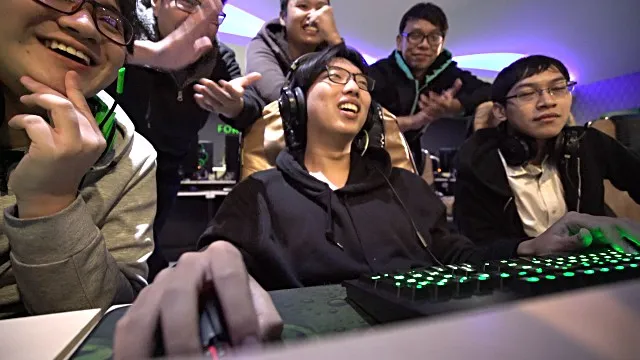
Too Many Games, Not Enough Growth: How Subscription Libraries Are Quietly Killing Your Skills

Photo: SAMHSA from Rockville, Public domain, via Wikimedia Commons
There's something genuinely exciting about booting up a subscription service and seeing hundreds of games staring back at you. Xbox Game Pass, PlayStation Plus Extra, Nintendo Switch Online — these platforms have fundamentally changed how Americans consume games. For a flat monthly fee, you get access to an enormous library. It feels like a win. And in a lot of ways, it is.
But here's the thing nobody's really talking about: all that convenience might be quietly training you to be a worse gamer.
Not worse in the obvious sense. You're still logging hours. You're still technically playing. But there's a difference between playing games and actually getting good at them — and subscription libraries, by their very design, are nudging you away from the latter.
The Buffet Problem Nobody Warned You About
Think about the last time you went to an all-you-can-eat buffet. You probably tried a little of everything, loaded your plate with options, and walked away full but maybe not totally satisfied. You didn't really savor anything.
That's subscription gaming in a nutshell.
Psychologists call it the paradox of choice — when you have too many options, decision-making becomes harder and satisfaction decreases. In gaming, this manifests as what a lot of players describe as "game hopping." You start a title, hit the first rough patch or slow section, and instead of pushing through, you think: why bother? There are 400 other games I could be playing right now.
And that's the trap. The friction that used to keep you in a game — the fact that you spent $60 on it — is gone. Subscription games cost you nothing extra to abandon. So you do.
Completion Rates Have Fallen Off a Cliff
This isn't just anecdotal. Studies tracking achievement data across platforms consistently show that completion rates on subscription-available titles are dramatically lower than games players purchase outright. When you buy a game, you're invested. When it's just sitting in a library you already pay for, the psychological stakes are almost zero.
For casual or story-driven games, that might not matter much. But for games that reward mastery — action RPGs, fighting games, shooters with deep mechanical systems — quitting early means you never reach the part where you actually learn something. You never hit the wall that forces you to adapt, strategize, or genuinely improve.
Skill development in gaming isn't linear. It usually looks like a plateau, then a breakthrough. Most players on subscription services quit during the plateau and never get the breakthrough.
Decision Paralysis Is a Real Time Sink
Here's another hidden cost: the time you spend choosing what to play.
SteamSpy data and informal surveys of Game Pass users frequently reveal that people spend 20-30 minutes just browsing before settling on something — and sometimes they don't settle at all, logging off without playing anything. That's time you could've spent actually gaming.
When your library is finite, choosing is easy. When it's effectively infinite, you're constantly second-guessing yourself. Should I be playing this, or would I enjoy that more? What if something better drops next month? It's mental overhead that wouldn't exist if you'd just bought one game and committed.
The Completionist Burnout Spiral
On the flip side, some players react to subscription libraries by going full completionist — trying to "get their money's worth" by blasting through as many games as possible. This sounds productive, but it leads to its own burnout cycle.
Chasing platinum trophies or 100% completion across dozens of titles simultaneously is exhausting. You're not playing for joy or growth anymore; you're playing to justify a subscription cost. Gaming becomes a second job, and the hobby that used to recharge you starts to drain you instead.
Both extremes — the chronic quitter and the manic completionist — are symptoms of the same underlying issue: subscription services shift your relationship with games from intentional to reactive.
How to Reclaim Intentional Gaming Habits
None of this means you should cancel your subscriptions. That would be throwing the baby out with the bathwater. Game Pass and PS Plus Extra genuinely offer incredible value, and there are smart ways to use them without falling into these traps.
Pick one game and commit. Treat your current subscription game like a purchase. Give it at least five to eight hours before you consider moving on. Most games don't open up until you're past the tutorial phase anyway.
Use a personal queue. Don't browse the full library when you sit down to play. Before the week starts, pick two or three games you want to focus on and stick to that short list. Limit your own options intentionally.
Set a completion goal before you start. Decide upfront what "done" means for this game — main story, a specific number of hours, a particular achievement set. Having a defined endpoint keeps you engaged through the tough middle sections.
Schedule "deep dive" months. Pick one game per month and go all-in. Try to genuinely master it. Learn its systems, explore its mechanics, watch community content about it. This is how you actually develop as a gamer.
Audit your actual playtime. Xbox and PlayStation both offer playtime tracking. Pull up your stats and be honest with yourself. If you have 47 games with under two hours each, that's a pattern worth breaking.
Play Smarter, Not Just More
Subscription services aren't the enemy — your habits around them might be. The ninja move here isn't to resist the buffet entirely; it's to walk in with a plan. Know what you want, focus on it, and don't let the endless scroll convince you that the next game is always going to be better than the one you're already playing.
Because here's the truth: the best game in your library is the one you're willing to stick with long enough to actually get good at it.